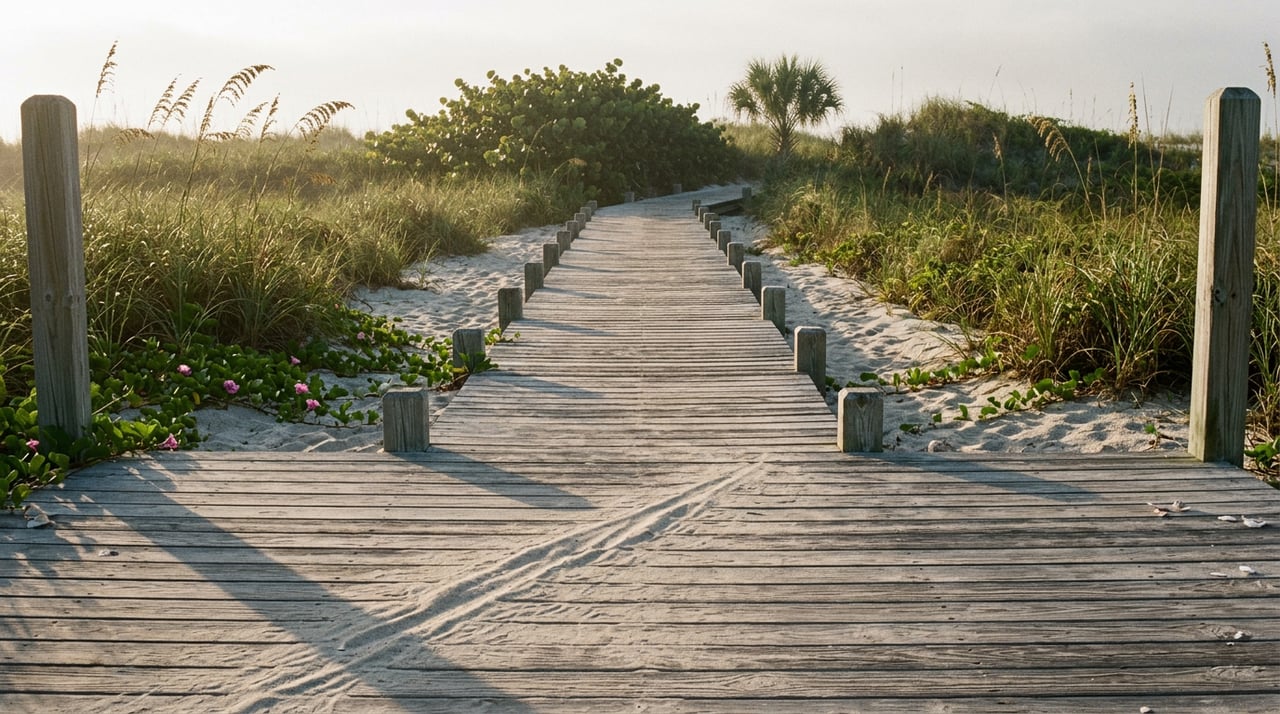
Drive down Ben Franklin Drive this week and you will see something new parked south of the Lido Beach Pavilion: earthmoving equipment, staged and waiting. It arrived over the past two weeks, and as of September 21, crews are shaping it into something that has not existed on this stretch of coast in years, a continuous line of protective dunes running roughly 1.2 miles from North Lido Park down past the Pavilion to South Lido Park.
If you have been walking that beach since late May, you might reasonably think the story already ended. The sand is wide again. The pipeline that once snaked along the shoreline pumping in new material is gone. The city cut a ribbon. Case closed, right?
Not quite. What finished in May was the renourishment, a $12 million, fully federally funded project that restored the beach's width after storms had stripped away as much as 90 feet of shoreline in some stretches since the last renourishment cycle in 2021. What started on September 21 is a different animal entirely, with its own budget, its own contractor, and its own reason for existing.
Width and Structure Are Not the Same Project
Renourishment answers one question: how much sand is on the beach. Dune restoration answers a different one: does that sand do anything when a storm pushes water toward the island. Right now, on the beach you have been visiting all summer, the answer to the second question is not much. The flat, wide profile that looks so complete in photos is, structurally, one of the least storm-ready versions of Lido Beach you will see all year.
Acting Assistant City Engineer Alex Davis-Shaw put it plainly when the project was announced earlier this month. The new dunes will be modest, about 2 to 2.5 feet high and roughly 30 feet wide with a gradual taper. Beachgoers, she said, will likely not notice much of a difference in how the beach looks. The impact, though, will be far bigger than the height suggests. That gap between what you will see and what the project actually does is the thing most beach walkers here have been missing since May.
What's Actually Happening Between Now and Late November
The mechanics are straightforward. The sand for the dunes, about 3,000 cubic yards of it, came from the same U.S. Army Corps of Engineers maintenance dredge at New Pass that supplied the earlier renourishment. Once it is shaped into place, crews will plant Florida-friendly vegetation, the same sea oats and native salt-tolerant species that hold dune systems together on barrier islands up and down this coast. City officials expect the work to take about 60 days, which puts a reasonable completion window somewhere in mid to late November, weather and hurricane season permitting.
Here is the rough shape of the year, if you want the full arc:
- January through late May: the renourishment project ran, with the Army Corps dredging roughly 300,000 cubic yards of sand from New Pass and pumping it south onto the shoreline
- May 26: the city held its ribbon cutting for the completed renourishment
- June 20: the Ritz-Carlton reopened its Lido Key Tiki Bar after a year and a half rebuild following hurricane damage, a separate but symbolically connected marker of the island's recovery
- September 8 through 14: equipment began mobilizing for the dune phase
- September 21: dune construction began
- Late November, roughly: dune construction is expected to wrap, with walkover replacement work continuing into 2027
Public Works Director Nikesh Patel has been the steadiest voice explaining why the sequencing matters. The dunes, he said, are meant to protect the upland property and Ben Franklin Drive itself, slowing future erosion in a way that flat sand alone cannot. It is not only good for tourism, he noted, but for the infrastructure and properties that sit just behind the beach.
Access Stays Open, But How You Walk the Beach Is About to Change
If you are worried this closes the beach, it does not. City officials have been consistent on this point across every briefing: public access to Lido Beach will be maintained throughout the entire 60-day project. The Pavilion, concessions, the pool, the north parking lot, and the Bay Runner Trolley all continue operating without interruption. Equipment is staging in the parking lot south of the Pavilion, which is the one area where you will notice construction activity most directly.
What will change, once the work is done, is how you move across the sand. Your Observer reported that City Engineer Sage Kamiya described the project happening in stages, with crossings marked by posts and ropes as each section is completed.
"It's going to have to be done in stages, and as they are done there are going to be crossings between the dunes marked with posts and ropes," Kamiya said. "There will always be access to the beach."
That last line matters more than it sounds. Right now, Lido Beach is essentially open sand from the dune line to the water, and you can wander wherever you like. Once this project wraps and the vegetation takes hold, the beach will have a defined dune edge with specific pedestrian crossings, not unlike the boardwalk-and-dune systems you see on beaches further up the Gulf Coast. It is a permanent shift in how the space is used, not just a temporary construction inconvenience.
Two Projects, Two Very Different Budgets
Part of what makes this story easy to misread is that most people assume "the beach project" is a single line item. It is not. The renourishment carried a $12 million price tag, covered entirely by federal disaster relief dollars secured through the Army Corps of Engineers, funding tied to a 50-year agreement that calls for renourishment roughly every five years. The dune phase is a comparative bargain at about $1.2 million, including roughly $700,000 in construction costs, drawn from a different pool that includes local tourist development tax revenue and state environmental grant support.
The distinction is not just bureaucratic trivia. It explains why the sand showed up first and the structural protection is arriving months later: these are two separate funding streams, two separate approval processes, and two separate contractors, stitched together into what only looks like one continuous beach project from the outside.
What to Actually Expect on Your Next Walk
If you are heading to Lido Beach this week, expect to see machinery near the Pavilion parking area and crews beginning to shape sand into low ridges along the shoreline. You will not see much height difference at first. Over the coming weeks, as vegetation goes in and the dune line takes hold, that will start to change, and by the time you are back on the beach for the holidays, you should be walking past an actual dune system for the first time since before the 2024 hurricane season did its damage.
The engage.sarasotafl.gov project page has ongoing updates if you want to track progress directly, and it is worth a bookmark if you live nearby or walk this stretch regularly. For anyone curious about where the dune line ties in on the south end, Ted Sperling Park at South Lido Beach remains open on its usual schedule throughout construction, with its trails, kayak launch, and observation areas unaffected by the work happening farther north.
The beach that reopened in May told half the story. The one taking shape now, sand plus structure, vegetation plus a marked pedestrian layout, is the version built to actually hold up the next time a storm pushes water toward this island. That is worth knowing the next time someone tells you the Lido Beach project finished back in the spring.
If you are thinking about what life on Lido Key looks like beyond this season, from beach access to the rhythm of island life, Toni Schemmel and the Schemmel Milland team know this stretch of coast the way only people who watch it change year over year can. Reach out anytime you want a local read on what is actually happening here, not just what the photos suggest.